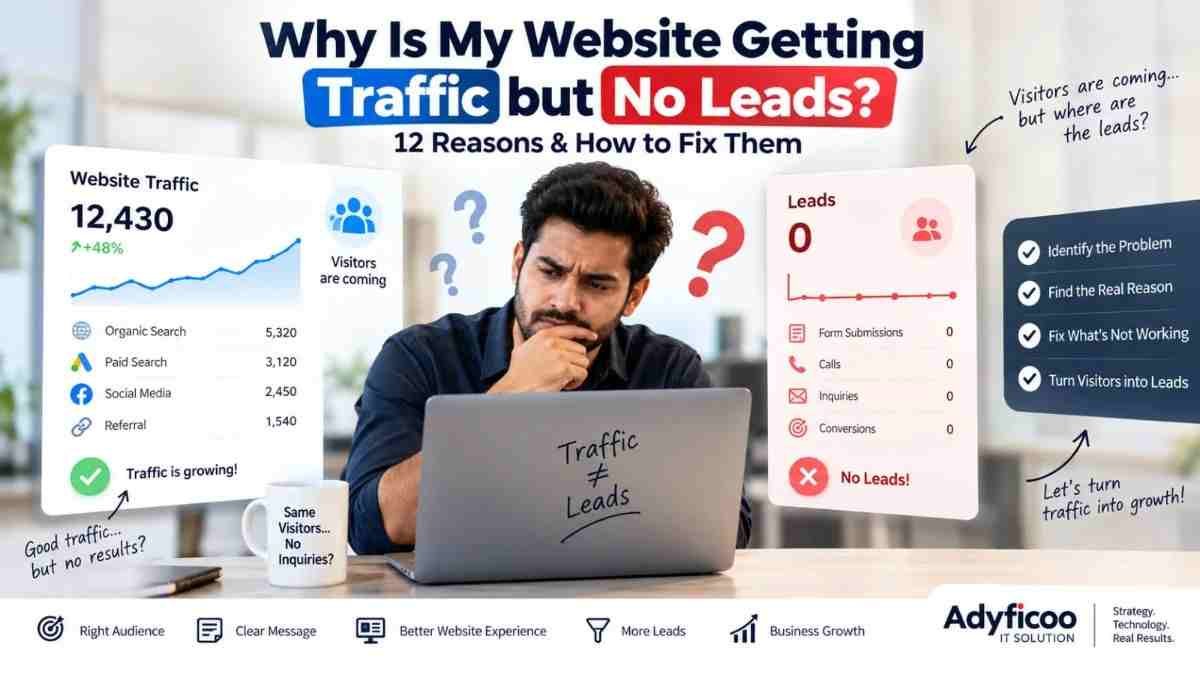
Why Is My Website Getting Traffic but No Leads? 12 Reasons & How to Fix Them
Introduction: Traffic Doesn't Equal Leads
Getting visitors to your website is important, but traffic alone doesn't grow a business. If you are website getting traffic but no leads, the problem may not be your traffic volume at all. It could be what happens after someone arrives.
A visitor needs a relevant reason to stay, understand your offer, trust your business, and take the next step. If any part of that journey breaks, you can have plenty of visitors without generating enough inquiries, calls, bookings, or sales.
Here are 12 common reasons this happens and what you can do about each one.
1. You're Attracting the Wrong Traffic
Not every visitor has buying intent. Your website may be attracting people who are researching a topic, looking for free information, or simply outside your target market.
Check your traffic sources, search queries, locations, landing pages, and audience data. If visitors aren't a good match for your product or service, increasing traffic won't solve the problem.
Fix: Focus on attracting people who have a genuine need for what you sell. Align your SEO topics, advertising audiences, and content with commercial intent where appropriate.
2. Your Website Doesn't Match Search Intent
A visitor clicks expecting one thing and finds something different. For example, someone searching for "SEO services for small businesses" may not want a general article about what SEO means.
The page needs to satisfy the reason behind the search.
Fix: Identify the intent behind important keywords and make sure the landing page delivers what the visitor expected. Google also emphasizes creating helpful content for a clearly defined audience rather than content created primarily to attract search traffic.
3. Your Landing Page Isn't Built to Convert
A page can look professional and still fail to generate inquiries.
Visitors should quickly understand the problem you solve, what you offer, why your solution is relevant, and what they should do next.
Fix: Strengthen the headline, value proposition, supporting proof, relevant information, and next step. Remove distractions that compete with the main action.
4. Your CTA Is Weak or Missing
A visitor shouldn't have to figure out what to do next.
A weak or unclear call to action can create unnecessary hesitation. Depending on the business, the next step might be requesting a quote, booking a consultation, starting a project, calling the company, or requesting a demo.
Fix: Use clear, specific calls to action that match the visitor's stage in the buying journey.
5. Your Offer Isn't Clear
Sometimes the problem isn't the website design. The offer itself isn't clear enough.
Within a few seconds, a visitor should be able to understand:
What you offer
Who it is for
What problem it solves
Why your solution is relevant
What they should do next
Fix: Rewrite your main messaging around the customer's problem and desired outcome instead of simply listing features or services.
6. Your Website Looks Untrustworthy
People are unlikely to share their information with a business they don't trust.
Look for missing or weak trust signals such as customer reviews, testimonials, case studies, company information, contact details, client examples, and clear policies.
Fix: Make credibility visible throughout the website. Trust should be supported by the overall experience rather than relying on one badge or testimonial.
7. Your Website Is Too Slow
Performance can affect the experience visitors have on your site. Large images, unnecessary scripts, excessive plugins, or technical problems can make pages feel slow.
Google's Core Web Vitals focus on loading performance, responsiveness, and visual stability through metrics including LCP, INP, and CLS.
Fix: Test important pages with appropriate performance tools, compress large assets, review unnecessary scripts, and address significant technical bottlenecks.
8. Your Website Isn't Mobile-Friendly
A website can work perfectly on a desktop and still be frustrating on a phone.
Check whether visitors can easily read your content, navigate menus, tap buttons, complete forms, and find important information without excessive scrolling or zooming.
Fix: Test the complete conversion journey on real mobile devices, not just the homepage.
9. Your Lead Form Has Too Much Friction
Every unnecessary step can create another opportunity for someone to abandon the process.
Long forms, confusing instructions, technical errors, and unclear expectations can all create friction.
Fix: Ask only for information that is genuinely necessary at that stage. Make the form easy to understand and clearly explain what happens after submission.
10. You're Targeting the Wrong Keywords
Ranking highly doesn't automatically mean you're attracting valuable visitors.
A business may receive traffic from broad informational searches while its actual customers use more specific, commercial, or location-focused searches.
Fix: Review which queries generate traffic and compare them with actual business outcomes. Build relevant landing pages around searches that reflect genuine customer needs.
11. Your Google/Meta Ads Are Bringing Low-Quality Visitors
Paid campaigns can generate clicks without generating enough qualified inquiries when targeting, messaging, creative, offers, or landing pages aren't aligned.
Google recommends matching ad messaging, keywords, and landing-page content so that users find what they expect after clicking.
Fix: Review targeting, campaign objectives, ad-to-page relevance, audience quality, and actual lead quality rather than judging campaigns only by clicks.
12. Your Tracking Isn't Working Properly
Sometimes the marketing isn't the problem. The measurement is.
A visitor may submit a form or complete another important action, but the event may not be recorded correctly in your analytics or CRM.
Google Analytics uses events to measure interactions such as clicks, purchases, and other actions. Important business actions can then be marked as key events for reporting and analysis.
Fix: Test forms, phone tracking, analytics events, Google Tag Manager implementations, CRM integrations, and conversion reporting before deciding that your marketing isn't working.
How to Generate Leads From Website Traffic
The best approach is to stop looking at traffic as the final goal and instead examine the complete visitor journey.
Ask:
Is the right audience arriving?
Are they engaging with the page?
Do they understand the offer?
Can they easily take action?
Is that action being recorded correctly?
This creates a simple framework:
Traffic → Engagement → Conversion → Lead
Traffic → Engagement → Conversion → Lead
Conversion Rate Optimization: How to Find Conversion Problems
You don't always need more visitors. Sometimes you need to make better use of the visitors you already have.
Review your highest-traffic pages and ask where people are dropping out. Compare traffic sources, landing pages, device types, engagement, form starts, completed submissions, and qualified leads.
Then make changes based on evidence rather than assumptions.
Website Lead Generation: Building a Better Conversion System
Effective lead generation is rarely about one button or one marketing channel. It comes from connecting the right audience with the right message, a useful website experience, a clear offer, an easy conversion path, and reliable measurement.
That is why SEO, paid advertising, website development, analytics, CRM, and automation should work together rather than operate as isolated activities.
Final Takeaway
If your website is receiving visitors but not producing enough business, more traffic may not be the first solution.
First identify where the journey is breaking.
The goal isn't simply:
More traffic.
The goal is:
Right audience + right message + strong website experience + clear offer + easy conversion path + accurate tracking.
How Adyficoo IT Solution Can Help
At Adyficoo IT Solution, we help businesses look beyond traffic numbers and focus on what happens after visitors arrive.
From SEO and Google Ads to Meta Ads, website development, tracking, CRM, lead generation, and business automation, we can help identify gaps in your digital customer journey and build a more effective system for turning relevant visitors into business opportunities.
If your website is getting attention but not enough inquiries, the first step is to find where the conversion process is breaking.