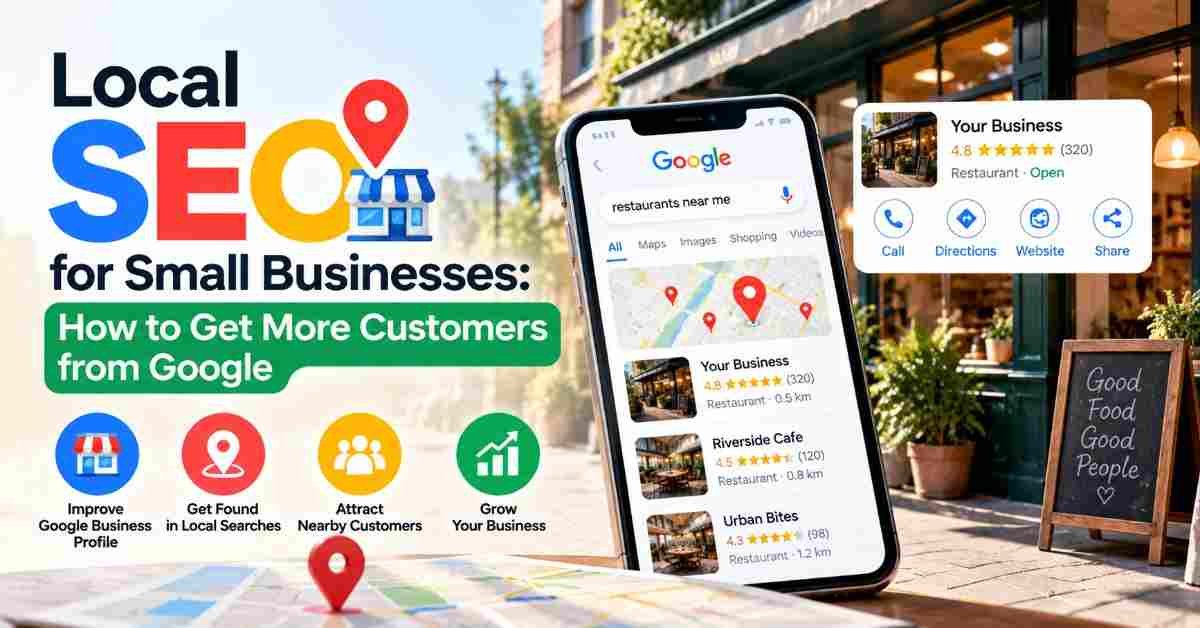
Local SEO for Small Businesses: How to Get More Customers from Google
Imagine you own a clinic, restaurant, retail shop, or service-based business. People in your area are searching on Google for the products or services you offer, but they are finding your competitors instead. The problem may not be your service quality; potential customers may simply struggle to discover your business online.
Local SEO for small businesses helps improve your visibility when nearby customers search for relevant products and services on Google Search and Google Maps. By improving your business profile, website, customer reviews, and local content, you can make it easier for potential customers to find you, contact you, and visit your business.
In this guide, you will learn practical ways to improve local visibility, attract relevant customers, and measure your progress without relying entirely on paid advertising.
How Does Local Search Work, and Why Does It Matter?
Local search helps Google connect people with businesses that match their needs and location. For example, someone searching for a dentist nearby, a restaurant in Lucknow, or an electrician in their area may see local business listings alongside regular website results.
Google explains that local results are primarily influenced by relevance, distance, and prominence. Relevance describes how well a business matches a search, distance refers to how far it is from the searcher or location mentioned, and prominence relates to how well-known the business is.
You cannot control every factor, particularly the searcher's location, but you can improve the information Google has about your business.
Start by identifying what customers search for before making a purchase. A restaurant owner might focus on menu information, opening hours, location, and photographs. A home service provider might prioritise service descriptions, coverage areas, phone accessibility, and genuine customer reviews.
The goal is not simply to appear in search results. It is to attract people who are likely to become customers.
Google Business Profile Optimization: Practical Steps for Better Local Visibility
Your Google Business Profile is often one of the first places potential customers learn about your business. It can display your contact details, operating hours, photographs, reviews, and directions.
To improve your profile, follow these steps:
Claim and verify your profile. Confirm that you are authorised to manage the business.
Choose the right categories. Select the most accurate primary category and add relevant secondary categories where appropriate.
Complete your information. Keep your business name, address or service area, phone number, website, and opening hours accurate.
Add genuine photographs. Show your premises, products, team, completed work, or services.
Describe your services clearly. Help potential customers understand what you offer and whether it meets their needs.
Encourage honest reviews. Invite genuine customers to share feedback and respond professionally to positive and negative reviews.
For example, a dental clinic should make its location, appointment contact details, services, and opening hours easy to find.
Avoid adding extra keywords to your business name unless they are genuinely part of its real-world name. Do not purchase reviews or create fake listings to influence rankings.
Google confirms that accurate business information helps it match businesses with relevant searches. It also explains that local visibility depends on relevance, distance, and prominence.
Local Business SEO: Website Improvements That Support Local Discovery
Your website helps potential customers understand your services, evaluate your credibility, and decide whether to contact you.
Use these practical improvements:
Create useful service pages: Give each major service its own page when it has distinct customer needs. Explain what you offer, who it helps, and how customers can enquire.
Make contact information visible: Include a working phone number, contact form, and accurate business details.
Improve mobile usability: Ensure visitors can read content, navigate pages, and contact you easily from a phone.
Improve loading performance: Compress oversized images, remove unnecessary scripts, and check your website's performance.
Publish genuinely useful local content: Answer questions customers in your area actually ask, rather than publishing repetitive city-name variations.
Connect related pages: Link relevant blog articles to service pages and make important pages easy to discover.
For example, a local electrician could publish a detailed page explaining residential electrical services, the areas genuinely covered, common customer questions, and how to request an appointment.
You can also ask a developer to implement appropriate Local Business structured data. This provides search engines with clearly organised business information, but it does not guarantee improved rankings or special search-result displays.
Local SEO Services: What Should Small Businesses Prioritise?
Not every business needs the same optimisation plan. A new clinic may need a complete business profile and website, while an established shop may need to improve its service pages, customer reviews, or tracking.
Prioritise work in this order:
Fix the fundamentals: Correct inaccurate business information, broken website pages, and missing contact details.
Improve relevance: Make your services, products, and location information clear.
Build trust: Collect genuine reviews, publish helpful information, and demonstrate your expertise.
Strengthen website quality: Improve usability, page speed, internal links, and technical accessibility.
Measure performance: Identify which activities lead to meaningful enquiries and sales.
If you hire an SEO provider, ask for an audit, a prioritised action plan, clear deliverables, and regular reporting. A trustworthy provider should explain what it will do, why the work matters, and how progress will be measured.
Be cautious of anyone guaranteeing the number-one position on Google or promising immediate results. No provider can control every ranking factor.
SEO Services in Lucknow: How Local Businesses Can Improve Their Reach
Businesses in Lucknow can make their online presence more useful by addressing the needs of customers in their actual market.
For instance, a clinic could explain its available treatments, appointment process, opening hours, and location. A restaurant could provide an accurate menu, photographs, and reservation details. A web design agency could explain its services, project process, and the types of businesses it supports.
Use the following approach:
Research the questions potential customers ask before choosing a provider.
Create dedicated pages for important services.
Explain relevant local requirements, customer problems, and service availability.
Maintain consistent business information across legitimate directories and your website.
Build relationships with relevant local organisations and businesses where there is a genuine reason to collaborate.
Publish original examples, guides, and frequently asked questions that help customers make informed decisions.
Avoid creating multiple near-identical pages for different neighbourhoods if the content offers no meaningful difference. Each page should provide genuine value to people in the location it discusses.
The objective is to demonstrate relevance to local customers while making your business information accurate and trustworthy.
Local SEO in Lucknow: A Practical Action Plan for the Next 30 Days
A structured monthly plan makes it easier to implement improvements consistently. Use this four-week checklist as a starting point and adjust it to your business needs.
Week 1
Audit your online presence
Check ownership and verification of your business profile.
Correct contact details, categories, and opening hours.
Review your website's contact page and important service pages.
Week 2
Improve your website
Update service descriptions and contact information.
Check mobile usability and page loading.
Add useful links between related pages.
Week 3
Build trust and relevance
Ask recent customers for honest feedback.
Respond to existing reviews.
Publish one useful article or service-related resource.
Week 4
Measure and refine
Review search impressions, website clicks, and enquiries.
Check calls and direction requests where relevant.
Identify weak pages and choose the next improvements.
Do not expect every change to produce immediate results. Use the first month to establish a strong foundation, record your starting performance, and identify the most useful next steps.

Common Local Search Mistakes to Avoid
Even a well-established business can miss opportunities because of simple mistakes. Check for these issues regularly:
Incorrect business details: Old phone numbers, outdated hours, or conflicting addresses can confuse customers.
Incomplete profiles: Missing services, photographs, or useful information can leave customers with unanswered questions.
Keyword stuffing: Repeating search terms unnaturally makes content less helpful.
Fake reviews: Purchased or fabricated reviews undermine trust and may violate platform policies.
Thin location pages: Pages with only a changed city name provide little value.
Ignoring mobile visitors: A difficult contact form or hidden phone number can lose potential enquiries.
Measuring rankings alone: Better visibility does not automatically mean more sales.
Focus on making your business easy to understand, trustworthy, and convenient to contact.
How to Measure Results and Improve Performance
Track whether your optimisation work helps customers discover and contact your business. Do not rely on one metric alone.
Google Search Console provides reports showing how frequently your website appears in Google Search and how often people click through.
Set a baseline before making major changes. Review comparable periods, account for seasonal differences, and connect website activity with actual business enquiries wherever possible.
For example, if website visits increase but enquiries remain unchanged, review whether your service pages answer customers' questions, whether your contact details are prominent, and whether your forms work correctly.
How Long Does It Take to See Results?
There is no universal timeline for better local visibility. Some improvements, such as correcting inaccurate opening hours, can help customers immediately. Changes to organic search visibility may take weeks or months to become noticeable, depending on the website, competition, location, and work completed.
Google also notes that local rankings cannot be purchased or guaranteed.
Review your progress monthly, continue improving useful content, and make decisions based on actual performance rather than promises of instant rankings.
Frequently Asked Questions
1. Can a small business appear on Google without a website?
Yes. An eligible business can have a Google Business Profile without a website. However, a website gives you more space to explain services, answer customer questions, and generate enquiries.
2. Are customer reviews important for local visibility?
Reviews help potential customers evaluate a business. Google also identifies review quantity and positive ratings as factors that can contribute to prominence. Always seek genuine feedback and avoid manipulating reviews.
3. Should every business create a Google Business Profile?
Businesses that meet Google's eligibility requirements can create a profile. Eligibility generally depends on having a real-world business location customers can visit or a business that travels to customers. Online-only businesses may not qualify.
4. How can I tell whether my local marketing is working?
Monitor profile interactions, website clicks, qualified enquiries, calls, appointments, and sales. Compare performance over time and investigate whether increased visibility is attracting the right customers.
Turn Google Visibility into Real Business Opportunities
Improving your online presence requires accurate business information, a useful website, customer trust, and consistent performance measurement. Adyficoo IT Solutions helps businesses identify digital marketing opportunities and develop strategies aligned with their business goals.
Visit Adyficoo IT Solutions to explore our services, or learn more about our SEO solutions. Discuss your business objectives with our team to identify practical opportunities for improving your online visibility and attracting relevant enquiries.